


Common MSME Compliance Mistakes to Avoid
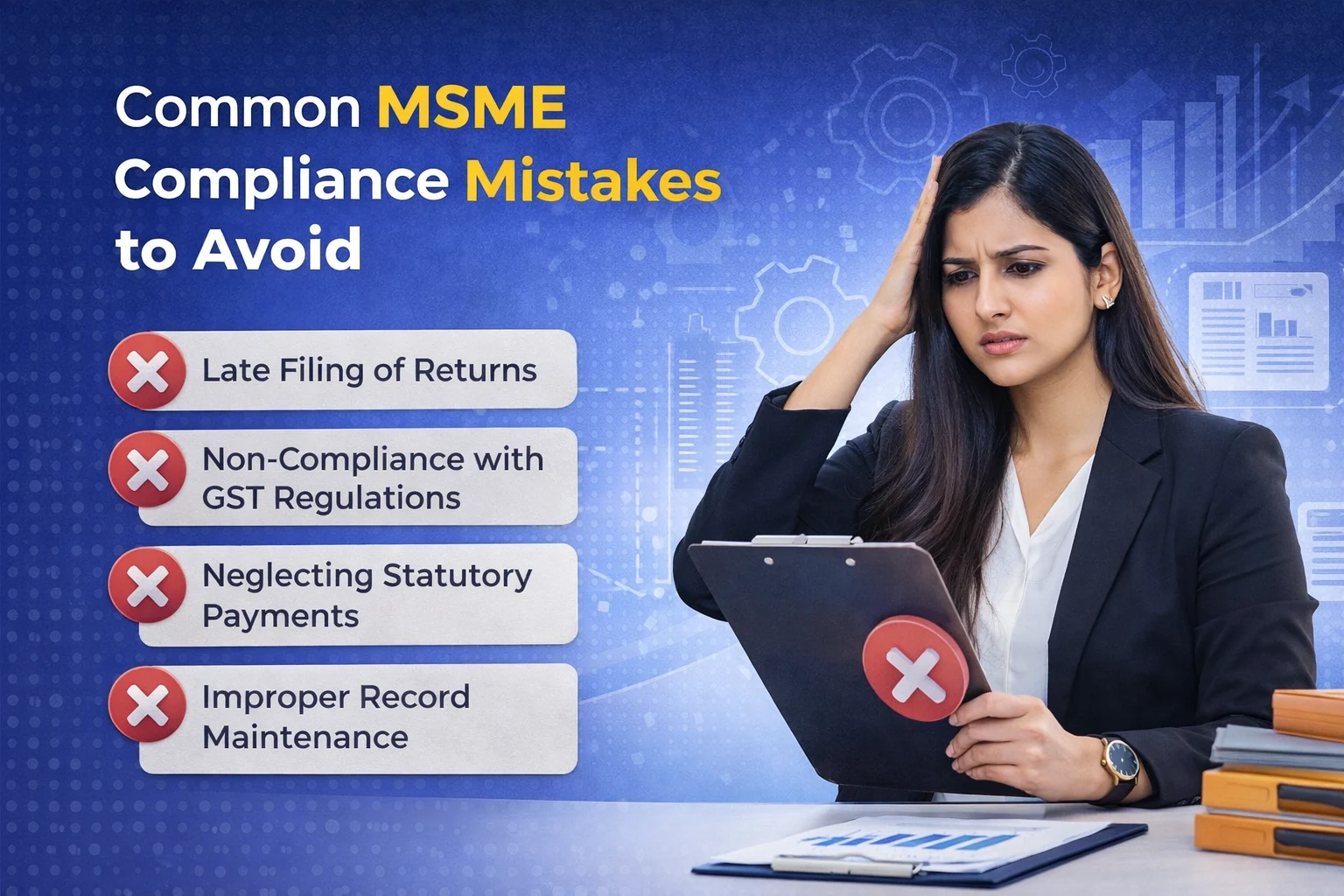
Running a Micro, Small, or Medium Enterprise in India comes with significant regulatory responsibilities. While government incentives and benefits make MSME Registration attractive, the compliance obligations that accompany it often catch business owners off guard. The challenge intensifies with digitisation and automated regulatory checks that detect filing inconsistencies faster than ever. Understanding the most common MSME compliance mistakes and how to avoid them can save your business from costly penalties, legal complications, and reputational damage.
Why MSME Compliance Matters More Than Ever
MSME compliance isn't just a bureaucratic requirement. In India, over 2.3 lakh companies were penalised for non-compliance in 2023 alone, collectively paying more than ₹350 crores in penalties related to payroll and tax violations. MSMEs face this burden despite having limited resources and often no dedicated compliance team.
The regulatory landscape has become increasingly stringent. Tax departments now match data across GST returns, income tax filings, and bank statements automatically. A small discrepancy in one filing can trigger cascading notices from multiple authorities. For MSMEs already operating on tight profit margins, these penalties can be business-threatening.
The good news: most compliance mistakes are preventable with proper systems, awareness, and timely action.
Mistake 1: Neglecting or Delaying GST Compliance
GST is one of the most critical compliance areas for MSMEs, yet it remains a minefield of errors.
Common GST Mistakes
Missing Filing Deadlines: Delays in filing GSTR-1 (outward supplies), GSTR-3B (monthly returns), and GSTR-9 (annual returns) are remarkably common. A single day's delay attracts a late fee of ₹50 per day (or ₹20 for nil returns), capped at ₹5,000 per return. Additionally, 18% interest accrues on unpaid tax amounts.
Incorrect Input Tax Credit (ITC) Claims: Businesses often claim ITC on ineligible expenses, such as food and beverages, personal items, or club memberships. Others claim ITC before their suppliers file returns, only to face reversals and penalties later.
GSTR-1 and GSTR-3B Mismatches: Your outward supplies in GSTR-1 must reconcile with the summary figures in GSTR-3B. Any discrepancy triggers automated system alerts and audit flags. The mismatch often stems from last-minute invoicing, manual entry errors, or poor record-keeping.
Invoice Discrepancies: Issuing invoices with incorrect GSTIN, wrong HSN/SAC codes, wrong tax rates, or missing mandatory details invalidates them. When invoices are incorrect, your customers cannot claim ITC, damaging vendor relationships and often resulting in complaints or requests for credit notes.
Ignoring NIL Returns: Many businesses assume that if there were no transactions in a month, they don't need to file. This is incorrect. Even nil returns are mandatory and must be filed by the due date. Non-filing attracts penalties regardless of whether tax was due.
How to Avoid GST Mistakes
Start by implementing GST filing software that automatically reconciles invoices with returns and matches your purchase records against GSTR-2A/2B monthly, not quarterly or annually. Maintain a master list of all suppliers' GSTINs and verify them before each transaction. Set automated calendar reminders for all GST filing deadlines (GSTR-1, GSTR-3B, GSTR-9) and review all invoices for GSTIN, HSN codes, and tax rates before sending them to customers. Create a policy requiring all GST returns to be filed at least 2-3 days before the official due date to avoid last-minute errors and technical glitches.
Mistake 2: Misclassifying Expenses and Revenues
Expense and revenue misclassification is one of the most common yet least understood compliance risks for MSMEs. This mistake often surfaces during tax assessments or audits, triggering multiple clarification requests and notices.
Types of Misclassification
Mixing Personal and Business Expenses: A common pitfall is treating personal expenses as business deductions. Using your business account to pay personal utility bills, mixing personal and business vehicle expenses, or claiming personal travel as business expense will not withstand scrutiny. Tax authorities easily catch these through bank statement analysis.
Confusing Capital and Revenue Expenses: Capital expenses (like purchasing machinery or office furniture) should not be fully deducted in the year of purchase. They must be depreciated over time. Revenue expenses (like repairs or maintenance) can be deducted immediately. The reverse classification inflates expenses in one year and reduces them in others, creating discrepancies across filings.
Incorrect Tax Treatment of Transactions: Different types of transactions have different tax treatments. For example, selling a used asset at a loss is not simply deductible, it requires specific treatment under capital gains rules. Discounting revenue without proper supporting documentation raises audit flags.
Real-World Impact
These misclassifications often emerge years later during tax audits. The tax department then issues detailed notices asking for clarification, supporting documents, and corrections. If found to be intentional, penalties of 50% to 200% of the underpaid tax can apply. Even if unintentional, you'll owe the unpaid tax plus 18% interest for the years in question.
Prevention Strategies
Maintain separate business and personal bank accounts and credit cards to naturally segregate transactions. Use accounting software that forces categorization of each transaction, preventing careless mixing. Work with a qualified accountant to establish a proper chart of accounts before your fiscal year begins. Review financial statements quarterly with your accountant to catch misclassifications early, and document the business purpose of every transaction, especially those that might appear mixed. Create a policy requiring receipts and invoices for all business expenses.
Mistake 3: Overlooking Payroll Compliance (EPF, ESI, Professional Tax)
Indian labour laws impose significant payroll-related compliance obligations on MSMEs. Many business owners underestimate these requirements, assuming they apply only to large corporations.
EPF and ESI Registration Requirements
Employee Provident Fund (EPF): Mandatory for organizations employing 20 or more workers. Both employer and employee contribute 12% of the employee's basic salary. Monthly contributions must be deposited by the 15th of the following month.
Employee State Insurance (ESI): Mandatory for establishments with 10 or more employees earning up to ₹21,000 per month. Employer contribution is 3.25% of wages, with employee contribution at 0.75%. ESI contributions must be paid by the 15th of the following month.
Professional Tax: Requirements vary by state, but most states impose professional tax on employees earning above a certain threshold.
Penalties for Non-Compliance
Late EPF payments incur penalties ranging from 5% to 25% per annum depending on the duration of delay. ESI payment delays attract 15% to 25% penalties per annum, plus potential legal prosecution under Section 85A of the ESI Act. ESI registration itself, if missed, can result in penalties of ₹10,000 plus ₹1,000 per day, while delayed registration triggers fines up to ₹5 lakhs with possible criminal prosecution.
Beyond financial penalties, non-compliance exposes your business to employee disputes. Disgruntled employees often file complaints with labor courts, leading to protracted and expensive legal battles that distract management and damage business operations.
How to Stay Compliant
Calculate your employee count accurately, including contractual and temporary workers, and register for EPF immediately upon hitting 20 employees; register for ESI upon hitting 10 employees. Set up automated monthly reminders for contribution payment dates and maintain accurate employee records including salary slips, attendance, and contribution details for at least 5 years. Use payroll software that automatically calculates and tracks EPF and ESI contributions, conduct quarterly reviews of payroll compliance with your HR team or accountant, and file monthly returns (Form 3A for EPF, monthly ESI returns) by the due date.
Mistake 4: Missing Company Law and ROC Filing Obligations
Every registered company must file annual returns and financial statements with the Registrar of Companies (ROC). This requirement applies regardless of profit or loss. Surprisingly, many MSME owners skip this step due to poor bookkeeping or sheer lack of awareness.
Critical ROC Filings
Annual Return (Form MGT-7): Must be filed within 60 days of the Annual General Meeting (AGM). This form discloses key information about the company including directors, shareholders, and authorized capital.
Financial Statements (Form AOC-4): Balance sheet and profit and loss account must be filed with ROC within 30 days of AGM approval.
Director Identification Number (DIN) Filings: Any changes in directors must be reported immediately.
Consequences of Non-Compliance
Late filings incur daily penalties of ₹100 per form with no upper limit, compounding over time. For example, a company filing six months late could face penalties exceeding ₹18,000 just on one return. Beyond financial penalties, the company faces additional fines ranging from ₹50,000 to ₹5 lakh for non-filing.
More critically, persistent non-filing can result in director disqualification under Section 164(2) if there are three consecutive years of non-compliance. The ultimate consequence is that the company can be struck off under Section 248, effectively ending its legal existence. This is irreversible and prevents the company from carrying on business, incurring liabilities, or conducting any legal proceedings.
Banks and investors rely on ROC records to verify business credibility. A history of missed filings makes it nearly impossible to secure bank loans, investor funding, or government contracts.
Prevention Approach
Maintain accurate books of accounts from day one and conduct annual financial statement closures immediately after the fiscal year-end. Schedule your AGM well in advance (at least 60 days before the filing deadline) and mark all ROC filing deadlines on a master calendar. File returns at least 10 days before the official due date to avoid last-minute rush and engage a company secretary or chartered accountant to monitor ROC compliance.
Mistake 5: Ignoring Timely Income Tax Return (ITR) Filing
Income tax return filing is mandatory for all MSMEs above certain income thresholds, yet many owners miss deadlines or file incomplete returns.
Key Points
Tax audits become mandatory when turnover exceeds ₹1 crore (or ₹5 crore if 95% of transactions are digital). Failing to file ITR by the due date results in penalties of up to ₹10,000 or the amount of tax unpaid, whichever is higher. Late filing also attracts interest at the rate of 1% per month on unpaid taxes, compounding quickly.
Filing incomplete or incorrect ITRs, such as misreporting income, over-claiming deductions, or failing to report capital gains, triggers assessment notices. The tax department then demands detailed explanations, supporting documents, and corrections. This process can extend over several years if the discrepancies are significant.
Avoid These ITR Mistakes
File your ITR within the official deadline (usually July 31st for the previous financial year) and report all income sources, including business income, other professional income, and investment returns. Claim only deductions for which you have supporting documentation. If you opt for presumptive taxation (Section 44AD), ensure your profit declaration aligns with the prescribed minimum rate. Maintain complete records of depreciation calculations, loan details, and major capital purchases, and reconcile your ITR with your GST returns, payroll records, and bank statements to ensure consistency across filings.
Conclusion
MSME Udyam Registration compliance is not optional, and ignorance is expensive. The regulatory environment continues to evolve, with stricter timelines, higher penalties, and better detection mechanisms. However, compliance mistakes are largely preventable with proper systems, timely action, and attention to detail.
The businesses that thrive are those that view compliance not as a burden but as a foundation for sustainable growth. Clean filings build credibility with banks, investors, customers, and government authorities. They open doors to schemes, subsidies, and opportunities that propel business growth.
Start today: audit your current compliance status, identify gaps, and implement systems to address them. The cost of action is far lower than the cost of inaction.
